


How to Adjust the Air Bypass Valve on a Porsche 3.2 Carrera Engine
On the Porsche 911 Carrera 3.2 (engine types 930/20–930/25, model years 1984–1989),
idle speed is adjusted via a mechanical air bypass screw on the throttle body. This engine
does not use an electronic idle control valve.
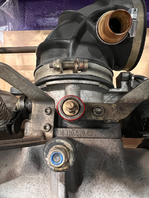 Purpose of the Air Bypass Valve
The bypass valve allows additional air to flow around the closed throttle plate, thereby setting the idle speed.
Preconditions Before Adjustment
Correct adjustment is only possible if the following conditions are met:
-
Engine fully warmed up
Oil temperature approx. 80–90 °C (175–195 °F)
-
All electrical loads switched off
Lights, blower fan, air conditioning off
-
Ignition timing correctly set
Approx. 3–5° BTDC at idle (depending on model year)
-
No vacuum leaks
Check intake hoses, vacuum lines, and throttle shaft
-
CO mixture not altered
CO is adjusted separately at the airflow meter using an exhaust gas analyzer
Location of the Air Bypass Screw
-
Located on top of the throttle body
-
Slotted screw (sometimes Allen/hex)
-
Easily accessible from above
Adjustment Procedure (Step by Step)
-
Start the engine and let it idle (fully warm)
-
Check idle speed
-
Target value: 800 ± 50 rpm
-
-
Adjust the bypass screw
-
Clockwise (in) → less air → idle speed decreases
-
Counterclockwise (out) → more air → idle speed increases
-
-
Make adjustments in ¼-turn increments
-
Wait a few seconds after each adjustment for the idle to stabilize
-
Set a smooth, stable idle at the specified rpm
Important Warnings !
-
Do not use the bypass screw to adjust the CO mixture
-
CO adjustment must be done only at the airflow meter and with proper measuring equipment
-
If idle speed barely changes during adjustment, likely causes include:
-
Vacuum leaks
-
Dirty throttle body
-
Faulty idle microswitch
-
Common Idle Problems
-
Hunting or surging idle → vacuum leaks or idle switch issues
-
Idle too high even with screw fully in → unmetered air leak
-
Engine stalls → bypass screw too far in or mixture too lean
Best regards
Jürgen Albert